




Our School
FAQs
SABIS® is a global education network with a long history that dates back to 1886. Today, SABIS® schools are present in 21 countries, on 5 continents, and educate students in both the private and public sectors.
SABIS® schools are dedicated to providing students with a top-quality international education through the implementation of the SABIS® Educational System, a 360o approach to education that places students on the path to success.
The SABIS® Philosophy is based on three important tenets. We believe that:
- A university education should be accessible to almost all students, not just a select few.
- Admission to any SABIS® school should be conducted through a non-selective admissions process.
- The success of a school should be measured by the value it adds to each student.
The SABIS® Educational System has proven itself over the past 135 years and is built on 6 important pillars:
1.The curriculum:
Students in SABIS® schools follow a dynamic, rigorous, international curriculum that gives them the strong foundation of knowledge and skills they will need to achieve future success. The curriculum is aligned to national and international standards and prepares students for external exams, such as the American SAT and Advanced Placement® (AP®), or the British IGCSE, as well as AS and A Level exams. In Brazil, students will also be prepared for the Science Diploma. This allows our students to apply to local Brazilian universities and international universities around the world.
2.SABIS® Book Series:
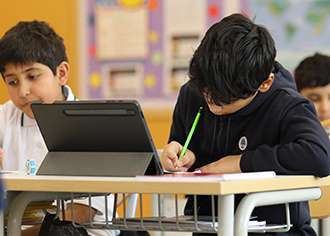
Students in all SABIS® schools use books that have been specifically written and developed for them. This allows students to follow a natural, sequential progression as they build their knowledge base. The SABIS® Book Series is specifically tailored for every grade level and subject and is aligned with national and international requirements, effectively preparing students for a wide range of external examinations. The SABIS® Book series includes over 3,100 books in both electronic (e-books) and traditional formats. In addition, bilingual books (in English and Portuguese) are available up to Grade 10 in Math, Physics, Biology, and Chemistry, allowing local students to transition into our system even if they have a lower level of English. Students in Grade 3 upwards will have access to our book series in an electronic format, allowing them to use the technological systems to improve their learning in and outside of school.
3.Teaching Methods:
Teachers in all SABIS® schools deliver their lessons using the SABIS Point System® of instruction. The SABIS Point System® is a proven instructional method that keeps students engaged and learning efficiently, through the use of interactive flipcharts, paced content, the Integrated Learning System (ILS), and many other tools and technologies. Every instructional period has distinct learning objectives to be met and includes opportunities for students to work independently and in groups under their teacher’s guidance.
4.Testing and Monitoring:
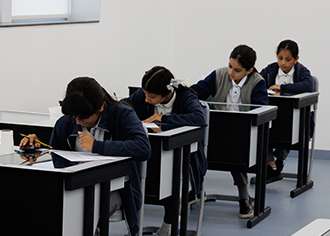
SABIS® schools use regular assessment to help students build a solid foundation of knowledge, particularly in the subjects of English and math, as well as world languages in some schools. In SABIS® schools, what we teach in one week, we test in the next.
Informative and summative examinations occur regularly throughout the school year, mainly AMS, Periodic, and Homework exams. Exams are generally computer-based, using the SABIS® Integrated Testing and Learning (ITL).
5.Follow-up and Support:
The progress of every student is continuously monitored through a series of regular tests. In addition to praise and encouragement, students are given the support they need. All available means are used to help those students who fall behind. Students are advised on study techniques, motivated by the academic staff, and encouraged by receiving help from peer tutors or teachers.
6.SABIS® Student Life Organization (SLO):
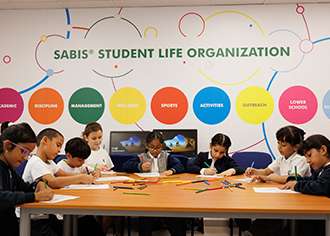
Students in SABIS® schools are encouraged to take an active part in their school and lead an engaging and meaningful social life. This is done through the SABIS® Student Life Organization or SLO, which is the beating heart of every SABIS® school. Through the SLO, students benefit from many opportunities for academic, emotional, social, and moral growth. Students also develop essential 21st century skills through real-life experiences.
SABIS® seamlessly shifted to its full-fledged E-learning solutions, which included live virtual lessons, a student learning environment, teaching videos, and more. And today, as countries began to reopen, many SABIS® schools implemented a hybrid model that allows students to study online and on campus. Regardless of their physical location, SABIS® students are continuing their education without missing a beat.
SABIS® International School – Aljada (SIS-Aljada) opened its doors in August 2021. In its first year of operation, the school welcomed students in Pre-Kindergarten through Grade 8. Today, the school serves students from Pre-Kindergarten until Grade 12.
The academic year starts in August and ends in June.
It covers 200 instructional days spread over 3 terms—Term 1 (15 weeks), Term 2 (14 weeks), and Term 3 (13 weeks). Each term has End of Term summary academic results.
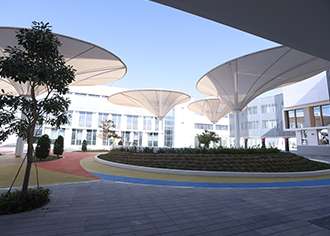
Once fully completed, the school will offer outstanding sports facilities that complement the extensive sports program offered: an indoor gymnasium, multiple outdoor tennis and basketball courts, a semi-Olympic heated pool, as well as a 200-meter and another 400-meter running track and field.
SABIS® International School - Aljada will also house a performing arts theater that can accommodate 400 guests.
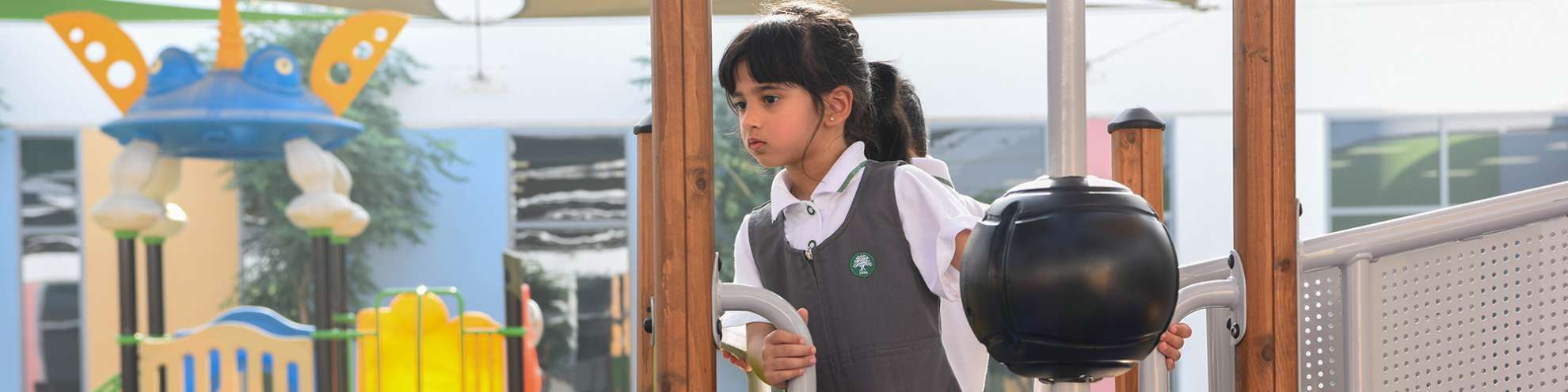
For the little ones, there are dedicated facilities tailored to their specific needs. The KG section will be situated in a separate building away from the rest of the school, where the youngest learners have access to their own heated pool, a mini-gymnasium, and extensive play facilities. One highlight is the car track for child-friendly carts, where children will be taught about traffic laws in a playful way from an early age!